
The White Shadow
Svensk version: Den vita skuggan.
I wanted to make an image of a room in which a person’s brain activity is measured, and where the result can be read off the wall of that same room. The starting point was the mirror galvanometer, an instrument without a pointer, where a beam of light does the pointer’s work. What began as a question about an instrument ended in a shadow that turns white.
The shadow that writes
The string galvanometer measures current with a single thread, thinner than a hair, stretched in a strong magnetic field. When current passes through the thread it bends sideways by a few hundredths of a millimetre. The movement is too small for the eye, so the instrument is at heart a microscope built straight through a magnet: a lamp shines in from one side, and on the other the enlarged shadow of the thread is thrown out.
In the room that shadow is dark, as shadows are. But photographic paper blackens where light strikes it, and where the shadow fell the paper stays untouched. After development the trace of the shadow is therefore the only thing that is light. Cornelius Borck describes the curves from Hans Berger’s string instrument in exactly those terms, as photographic negatives, with the white shadow of the filament on a blackened ground. When Berger later moved to a coil instrument with a mirror it was the other way round: a black line on white paper.
The white shadow, then, is the shadow seen afterwards. That is the thought the image tries to hold on to: the disc of light on the wall is the present, the sheet beside it is what remained, and each is the other’s opposite.
What is documented, and what is staged
The image is a staging and not a reconstruction, and the line between the two can be drawn fairly precisely. It is documented that Berger, in Jena, ordered the large Edelmann string galvanometer after his first trial on 6 July 1924, and that it came into use in February 1925. It is also documented that the subject lay down, completely at rest, with eyes closed in a darkened room, and that the electrodes sat at the temple and the back of the head.
The wall is staged. With Berger the shadow fell into a camera box, not out into the room, and no source I have read mentions projection before an audience. According to Borck he presumably gave only one public demonstration, before the medical society of Jena on 5 February 1930. The simultaneity is staged too: a sheet cannot hang developed on the wall while the measurement is under way. And the instrument is drawn from the principle, not from a particular specimen.
The person who actually did read a brain off a wall was Richard Caton in Liverpool in 1875. He measured on the exposed cortex of rabbits and monkeys with a Thomson mirror galvanometer whose image was projected on a wall. Two years later he described a weaker current from the scalp as well.
Two things in the sources make the staging more than a game. The first is a contradiction: the clear waves require closed eyes, so the person being measured cannot at the same time see their own deflection. Even so, Berger noted on 31 May 1929 that he intended to observe his own EEG with the help of a mirror from Zeiss, and in June that it worked. The second concerns what he believed he saw. He wrote that mental exertion adds only a small supplement to what he called the constant work of the cortex. I had a memory that a German researcher around 1913 had shown that the brain does not rest during sleep. In that form I have not been able to substantiate it. What exists is Berger’s constant work, and the sleep recordings Alfred Loomis made in the 1930s, in ink on a drum that could write for eight hours.
How the image came about
The work was done in rounds, in conversation with an AI assistant (Claude), and each variant was kept rather than overwritten. The images are drawn schematically. Two of them rest on assumptions that later proved uncertain, and they remain for that reason.
1. The spot on the wall
The mirror galvanometer has no pointer. A small mirror sits on the moving part, a lamp shines on it, and the reflected beam strikes a scale some distance away. When the mirror turns through a certain angle the beam turns through twice that angle, and since a beam of light weighs nothing the pointer can be made as long as one likes. A rotation that can barely be seen becomes a deflection of several decimetres. The image contains a deliberate anachronism: Caton measured on animals, and the human in the chair finds support only in his later observation from the scalp.
2. The red arch
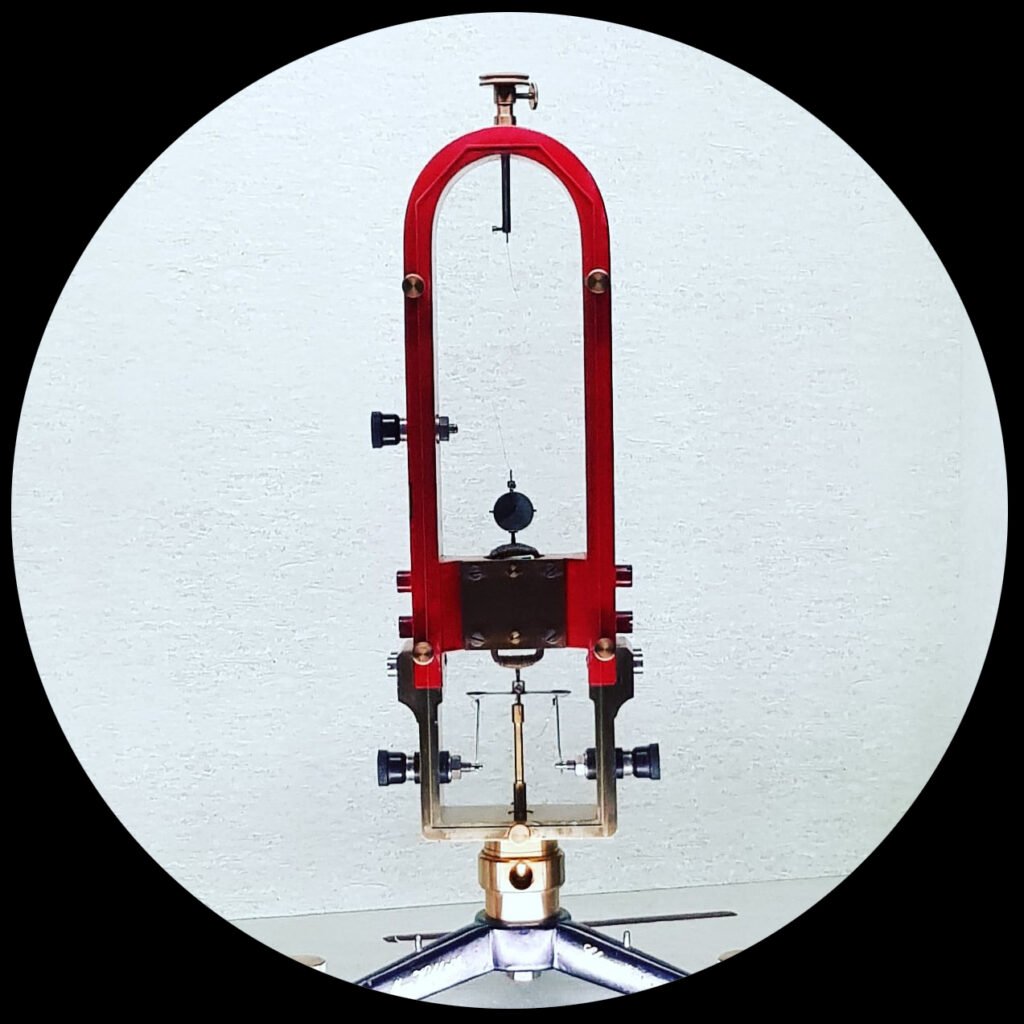
The second image came out of a photograph I took at Fondazione Prada’s exhibition on the brain in Venice in 2022: an instrument with a tall red arch, a thin thread and a small round disc. A similar detail appears with the physics collection at the University of Jena, which holds a Schleifengalvanometer, a loop galvanometer, as number 57 and states that Berger used an instrument of the same type. We read the arch as a horseshoe magnet and the thread as a loop with a mirror cemented across its two strands, so that the current turns the mirror.
That reading is uncertain. A Zeiss brochure from the 1950s describes the firm’s Schleifengalvanometer as an instrument in which one looks at the loop through a microscope, with no mirror. Whether number 57 is of that type, and whether it is the same instrument as in my photograph, I do not yet know. The image remains because the mistake led onwards: it was on the way to sorting out the loop that I arrived at the string and its shadow.
3 and 4. The shadow and the negative
The third image follows the sources more closely: the person is lying down, the instrument is a string galvanometer, and the reading is a shadow. The fourth is only the sheet. It was the words about the white shadow that turned the work. I had been looking for a way to make the measurement visible in the room, and found that the visible and the preserved are each other’s negative.
Open questions
Which instrument does the photograph from Venice show, and was it on loan from Jena? How were the Zeiss mirrors arranged when Berger watched his own EEG? And how does the phrase about the constant work of the cortex read in the original? I have read roughly half of Borck’s book in the freely available English edition; the rest remains.
Sources
- Cornelius Borck, Brainwaves: A Cultural History of Electroencephalography (Routledge 2018; German original Hirnströme, Wallstein 2005).
- Hans Berger, Über das Elektrenkephalogramm des Menschen, Archiv für Psychiatrie und Nervenkrankheiten 87 (1929).
- James L. Stone and John R. Hughes, Early History of Electroencephalography and Establishment of the American Clinical Neurophysiology Society (2013), on Caton.
- Friedrich-Schiller-Universität Jena, Sammlung wissenschaftlicher und technischer Geräte zur Physik.
- VEB Carl Zeiss Jena, Schleifengalvanometer, brochure, probably 1954.
- Fondazione Prada, Human Brains: It Begins with an Idea, Ca’ Corner della Regina, Venice, 23 April to 27 November 2022.


Pingback: lowend » Den vita skuggan